

In this article, we'll give some pointers for finding high-quality sound effects for your projects. Where you should be looking for them, whether they're paid-for or free sound effects, and other considerations that you should bear in mind when downloading sound effects libraries from the internet.
We might not all agree on the definition of "high quality" when in comes to sound effects, but we can probably align on a few factors. The files you use shouldn't contain background noise, should be of a high audio 'resolution' (bit depth and sample rate), and should be the right fit for the context of your wider project. You'll also likely want to pick royalty-free sound effects over others, or maybe even work with good-quality sounds for free. Read on and we'll give you some specific insights on what you should be considering when making your choice of where to source your sound effects.
1. Places To Go for High-Quality Sounds
Where to actually look for high-quality sound FX online
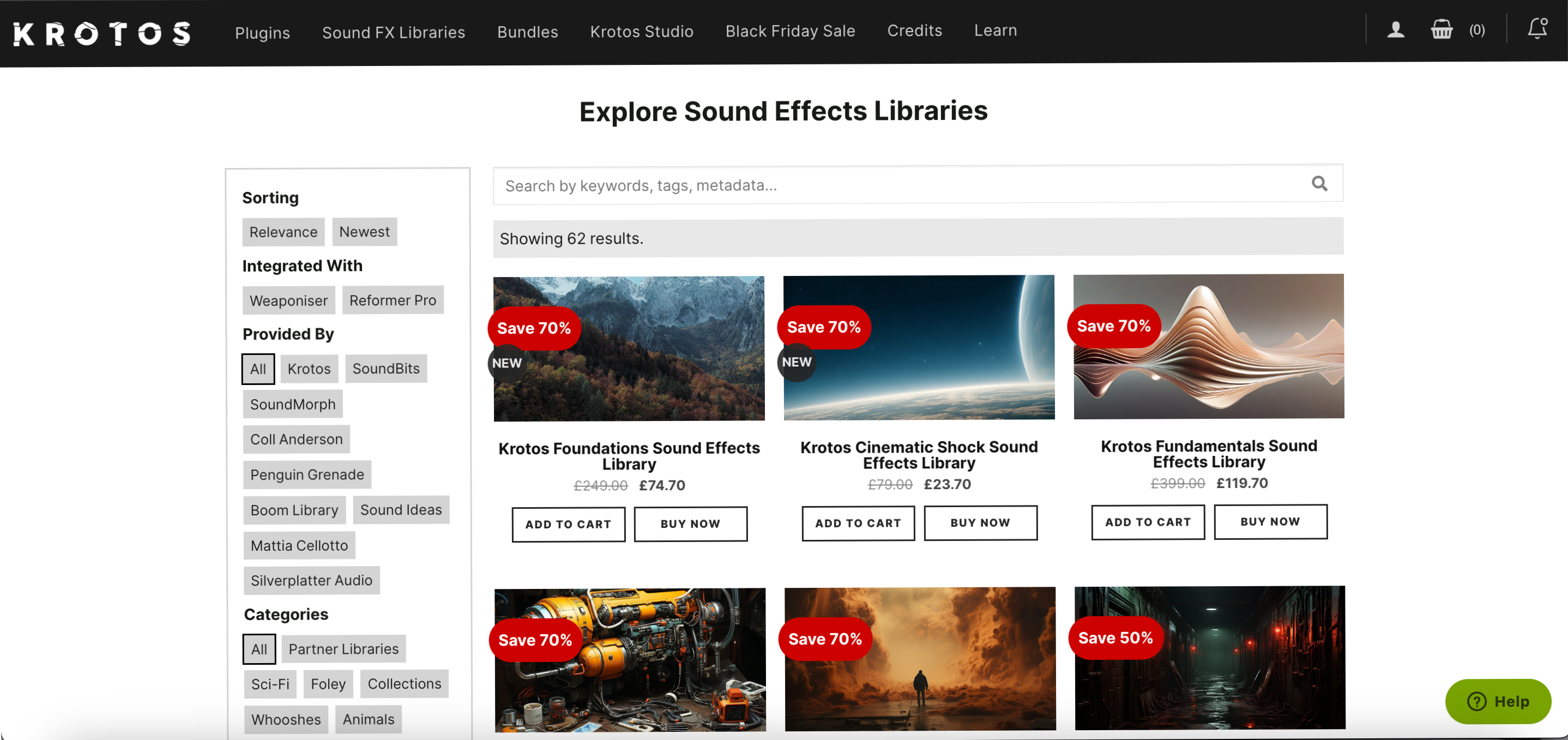
The first port of call for paid (and sometimes free) sounds is a certified online vendor or marketplace for royalty-free SFX, such as our very own Krotos Audio SFX Libraries. Websites like this will carry hundreds, or in some cases even thousands, of sound packs, depending on how cohesive the website's selection is trying to be. More specialised sites, such as Paul Stoughton’s Penguin Grenade, will have more specific sound pallets made to fit certain narrative genres or sonic aesthetics (in this case, sci-fi and experimental sound design). More generalised libraries, such as our own, will contain a selection of both genre-focused sounds and others with a broader use case, such as animal sound effects or Foley footsteps.
So if you're working on a project that will require highly specific sounds, finding a specialist will help you locate more unique sounds for your project that can bring your spaceships or dungeon-dwelling dragons to life. Of course, larger vendors often license and sell works from these creators when they can; for example, Krotos Audio also proudly hosts the work of Penguin Grenade and Mattia Celloto.
Other vendors we would like to highlight, such as industry mainstays A Sound Effect, can be found in a previous article about the best royalty-free sound effects library in 2025. There are also websites built specifically around free-to-download sounds. While the quality of the sounds on these sites varies hugely, and you cannot guarantee the sounds are royalty-free, there is some gold in places such as Free Sound if you know where to look. A more comprehensive list of free SFX websites can be found here if you're up for the hunt.
2. What do we Mean by High-Quality Sounds?
What to look out for, both in the format and content of your sound effects

As a general rule, whatever sounds you want to use should be in the highest possible quality you can get them in. Audio files, such as WAVs, even at their highest quality, are relatively small in size compared to a lot of other file formats, much to the chagrin of cameramen the world over. So don’t stress over storage when that extra amount of data can mean the difference between the monster in your game or film sounding realistic, or like a low-quality seal bark that has been pitched down. The higher the quality, the more processing, such as pitch shifting or time stretching, can be applied before digital artifacts become noticeable.
The standard audio quality for online sound FX vendors is 96,000Hz (96kHz)with a bit depth of 24, which is plenty big enough for any of the aforementioned edits. However, when it comes to mixing a film, the industry standard remains WAVs at 24-bit and 48,000Hz (48kHz). So if the sounds are only having effects such as reverb or distortion added to them, then you can get away with audio files of 48kHz. However, we would avoid this if you have the option, as you never know what you may need that sound for in a future project. You can always bounce a higher-quality sound into a lower-size format; this is not the case in reverse and can lead to headaches further down the production chain.
Outside of file type and size, audio quality can refer to how well the sounds themselves have been captured and how usable the sounds are. A poorly done recording can also be made at 96kHz, so don’t judge by the numbers and use your ears. Does it match the energy of the scene? Will it aesthetically mesh with other sounds you have already used, i.e. having a synthesised sound that clashes with the realistic design of the rest of the audio? Is it a mono file when it should be stereo? These are all things to consider when listening to your options.
One point we refer to often is whether there is enough variety of the same sounds within the sample pack. If you're going to use the sound a lot, like with footsteps or gunfire, then only having a few iterations of the sound will become noticeable incredibly fast. So in this case, the quality of a singular audio file can be perfect, but due to the lack of variation, the pack is of a lower quality as it simply isn’t as usable as one with, let's say, 15 variations of the same or similar gunshots.
Requirements like this are amongst the many reasons we made Krotos Studio, so you could get infinite variations of your bespoke sound without noticeable repeats of the same audio file.
3. Royalty Free and Other Considerations
Things to bear in mind and avoid, especially if you're being paid or the project itself is making money

The term has been mentioned a few times in this article already, so to clarify for anyone who may not know, royalty-free refers to copyrighted material that can be used by others in works for profit without having to pay any extra fees. In relation to sound, this means that once you have purchased a sound library (and therefore gained a license to use the sounds), you can use the material as many times as you want in as many projects as you want without having to pay anything else. This also extends to some free sound websites that claim to be royalty-free, but we recommend triple-checking the user agreement of the site and seeing whether that extends to each sound. Some sites, such as Free Sound, allow users to specify different Crative Commons licenses for their sounds.
Another thing to be aware of is whether the site you're purchasing or downloading the sounds from owns the license to distribute their content. Signs like not specifying that they are royalty-free or contain no copyright, not having an explicit user agreement page, or hosting audio that is instantly recognisable as someone else's copyright are instant red flags and should result in you not using the site or any of the sounds contained within it. What springs to mind are forum sites containing Skywalker Sound material from the Star Wars franchise, or sites distributing BBC Archive Sound Effects. This material is easily tracked by the copyright holders and can lead to fines or royalty payments if used improperly.
This is why we advocate for investing in high-quality sounds from vendors within the industry, so you can be sure that you can use the sounds without any extra hidden fees or legal issues.
